

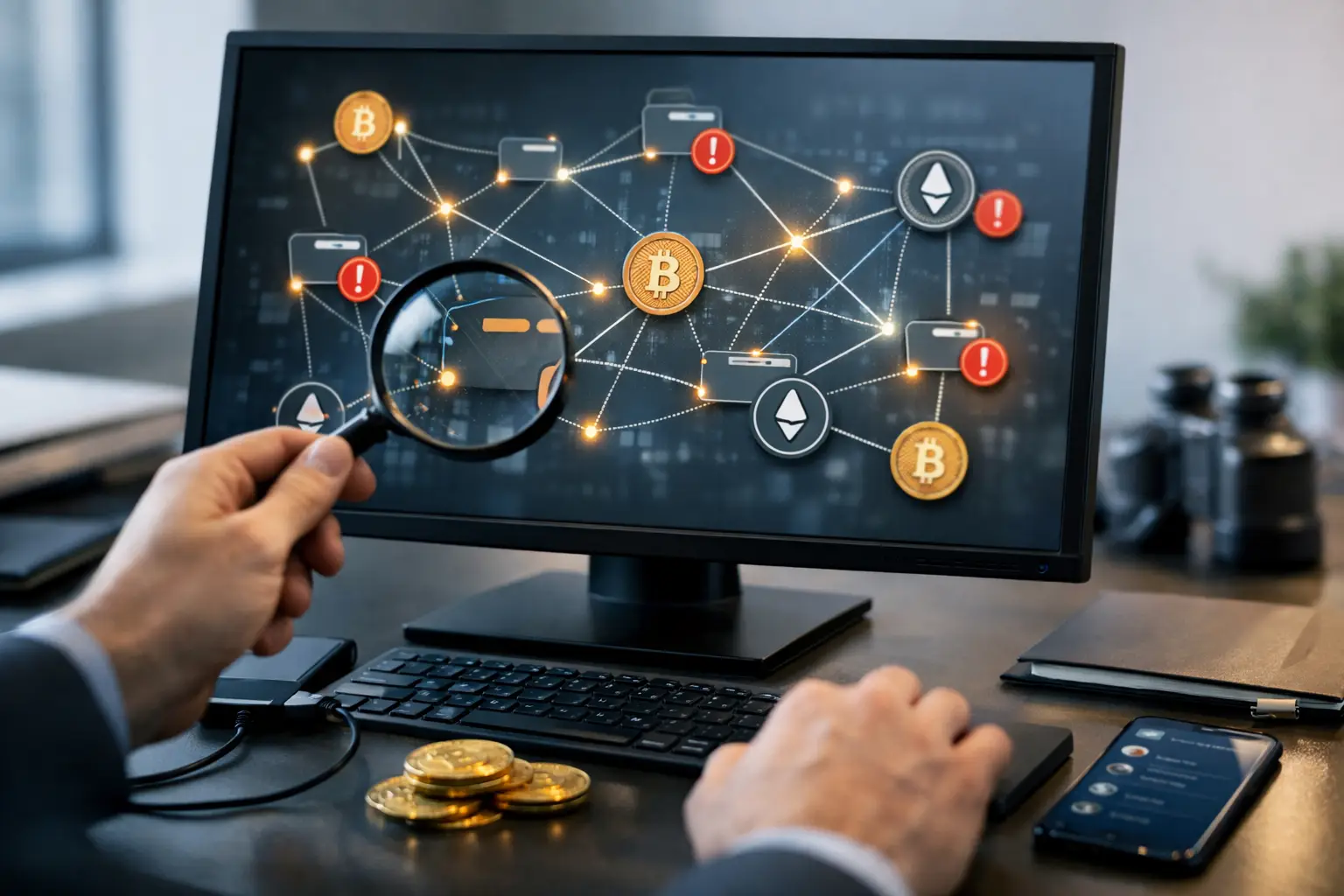
A wallet address can feel like the only remaining evidence after a cryptocurrency scam. It is not a name, a physical location, or proof of who controlled it. Yet public blockchains preserve a transaction record that can be examined. Learning how to map wallet connections helps turn a confusing series of transfers into a documented set of relationships, movements, and questions that can be evaluated by investigators.
For a scam victim, the objective is not to make assumptions from a single transaction. It is to establish what can be verified: where assets left, which addresses received them, whether funds were consolidated or exchanged, and which points in the trail may provide meaningful investigative leads.
Wallet mapping starts with evidence, not identification
A blockchain wallet is best understood as an address within a public ledger system. On networks such as Bitcoin and Ethereum, the ledger records transfers between addresses, transaction amounts, timestamps, transaction identifiers, and associated fees. This architectural transparency is valuable because records are generally persistent and independently reviewable.
It also has limits. An address does not inherently reveal the individual or organization behind it. A scammer may use many addresses, move funds through decentralized exchanges, transfer assets across networks, or send them to a service that pools customer deposits. Each step can complicate interpretation.
Forensic wallet mapping therefore separates confirmed facts from analytical inferences. A record may confirm that Address A sent assets to Address B at a stated time. It may support an inference that several addresses are operationally connected when they repeatedly move funds together or follow a coordinated pattern. It does not, by itself, prove personal identity, intent, or ownership.
That distinction matters when preparing records for law enforcement, counsel, an exchange compliance team, or a formal dispute. A credible tracing file shows its work.
How to map wallet connections from the first transaction
Begin with the transaction in which you sent funds or received suspicious funds. Preserve the original details before performing any analysis. Screenshots can help provide context, but they should not be the only record. Blockchain data can be independently checked, while screenshots alone can be incomplete or altered.
Record the wallet address you sent from, the receiving address, the transaction hash or transaction ID, the network used, the asset type, the amount, and the date and time shown by your wallet or exchange. Retain related communications, payment instructions, account statements, scam website addresses, and any identifying details supplied by the other party.
Next, verify the transaction directly on an appropriate blockchain explorer. Etherscan is commonly used for Ethereum and compatible networks. Blockchain.com can assist with Bitcoin transaction review, while SoChain can provide visibility for supported networks. Use the explorer that matches the actual network, not merely the asset name. For example, a token labeled USDT may have been transferred on Ethereum, Tron, Solana, or another chain, each with separate records and tools.
Confirm that the transaction hash, sender, recipient, amount, and timestamp match your records. If they do not match, stop and determine whether the wrong network, address, or transaction was selected. Small errors at this stage can send an investigation down the wrong path.
Follow outbound movements in sequence
Once the receiving address is confirmed, review its outgoing transactions after the scam payment arrived. The most relevant question is usually simple: where did the assets go next?
Create a chronological transaction path. Note every outbound transfer that may include the funds, including the recipient address, amount, date, time, transaction hash, and asset. Where an address receives multiple deposits, avoid claiming that a specific unit of cryptocurrency was transferred onward unless the transaction pattern supports that conclusion. Many wallets commingle funds. The evidence may show value movement through an address rather than a uniquely identifiable set of coins or tokens.
A practical map often begins as a table with one row per transaction. This approach is slower than drawing a diagram immediately, but it improves accuracy. A visual graph is useful only when the underlying transaction data has been verified.
Look for relationships, not just transfers
Wallet connections become more meaningful when examined as patterns. An address that receives many small victim payments and forwards them to a single destination may function as a collection point. Several addresses that transfer funds into one wallet within a short period may indicate consolidation. A wallet that sends nearly all incoming funds to another address after a recurring delay may suggest coordinated operational behavior.
These patterns are investigative indicators, not final conclusions. A legitimate business can also receive many payments or consolidate operational funds. Context determines significance. The surrounding evidence, such as identical scam instructions, synchronized transaction timing, repeated asset types, and communications with the fraudster, can strengthen or weaken an interpretation.
Build a map that another reviewer can verify
An effective wallet map should be understandable to someone who did not experience the scam and has no prior familiarity with the addresses. Each connection should be traceable to a source record on the relevant public ledger.
For every address in the map, document its first observed role. Was it the address provided by the scammer? Did it receive funds from multiple related addresses? Did it serve as a pass-through wallet? Did it receive an unusually large consolidation transfer? Record the facts first, then provide a clearly labeled analytical observation where appropriate.
Use consistent terminology. A useful distinction is between a source address, an intermediary address, a destination address, and a service-associated address. Labeling an address as “exchange-related” should be supported by verifiable explorer labeling or reliable attribution evidence. Do not assign a service name simply because an address appears active or receives many deposits.
Preserve transaction hashes exactly as displayed. They are the primary reference points that allow others to reproduce the review. Include the time zone used by the explorer and keep a copy of the information as observed, since address labels and interface displays can change over time.
Recognize the points where tracing becomes more complex
Some transaction paths remain visible but become harder to interpret. Token swaps may change one asset into another while retaining activity on-chain. Bridging can move value from one blockchain to another, requiring analysis of both the originating and destination networks. Smart contracts can receive assets and redistribute them through a series of contract interactions that are not obvious from a simple transfer list.
Centralized exchanges present a different issue. A transfer into a known exchange deposit address may identify a potentially important service touchpoint, but it does not reveal the account holder through public blockchain data alone. Exchanges maintain internal records that are not visible on the ledger. Those records may be relevant to an authorized law enforcement inquiry or other lawful process.
Privacy-focused tools, mixing services, and high-volume pooled wallets can reduce the certainty of an address-to-address path. This does not make the initial evidence worthless. It means the documentation must accurately state where the visible trail ends, where funds merge with other activity, and what further records would be needed to continue attribution.
Avoid common errors that weaken a tracing record
The pressure to recover money can make people act quickly, particularly when a person claiming to be a “recovery agent” promises to trace or reverse a transaction for an upfront payment. Treat such claims cautiously. A public ledger can document transactions, but it does not provide a mechanism to reverse a confirmed transfer or guarantee asset recovery.
Do not send additional funds to a wallet in an effort to “activate” a refund, pay a release fee, or prove ownership. Do not alter, delete, or overwrite original messages and account records. Keep a clear division between what the blockchain proves, what communications allege, and what an analyst reasonably infers from transaction behavior.
It is also prudent not to publicly accuse a person or entity based solely on an address connection. Wallet mapping is a method for documenting evidence and identifying leads. Attribution requires a higher evidentiary standard and often depends on records beyond the blockchain.
Turn the map into an investigative record
A useful final package includes a concise narrative, the transaction table, a visual relationship map, screenshots for context, and original source records. The narrative should explain the chronology in plain language: how contact began, how payment instructions were delivered, when assets were transferred, and how the receiving wallets moved the funds afterward.
The strongest records are disciplined rather than dramatic. They identify uncertainty, distinguish verified transactions from suspected connections, and allow each statement to be checked against public-ledger data. Education is often the most durable shield against fraud because it replaces urgency and speculation with a documented understanding of how a transaction trail behaves.
Transaction tracking cannot promise a recovery outcome, but it can uncover patterns for law enforcement discovery and help preserve the factual record before critical leads grow colder.
Leave a Reply