

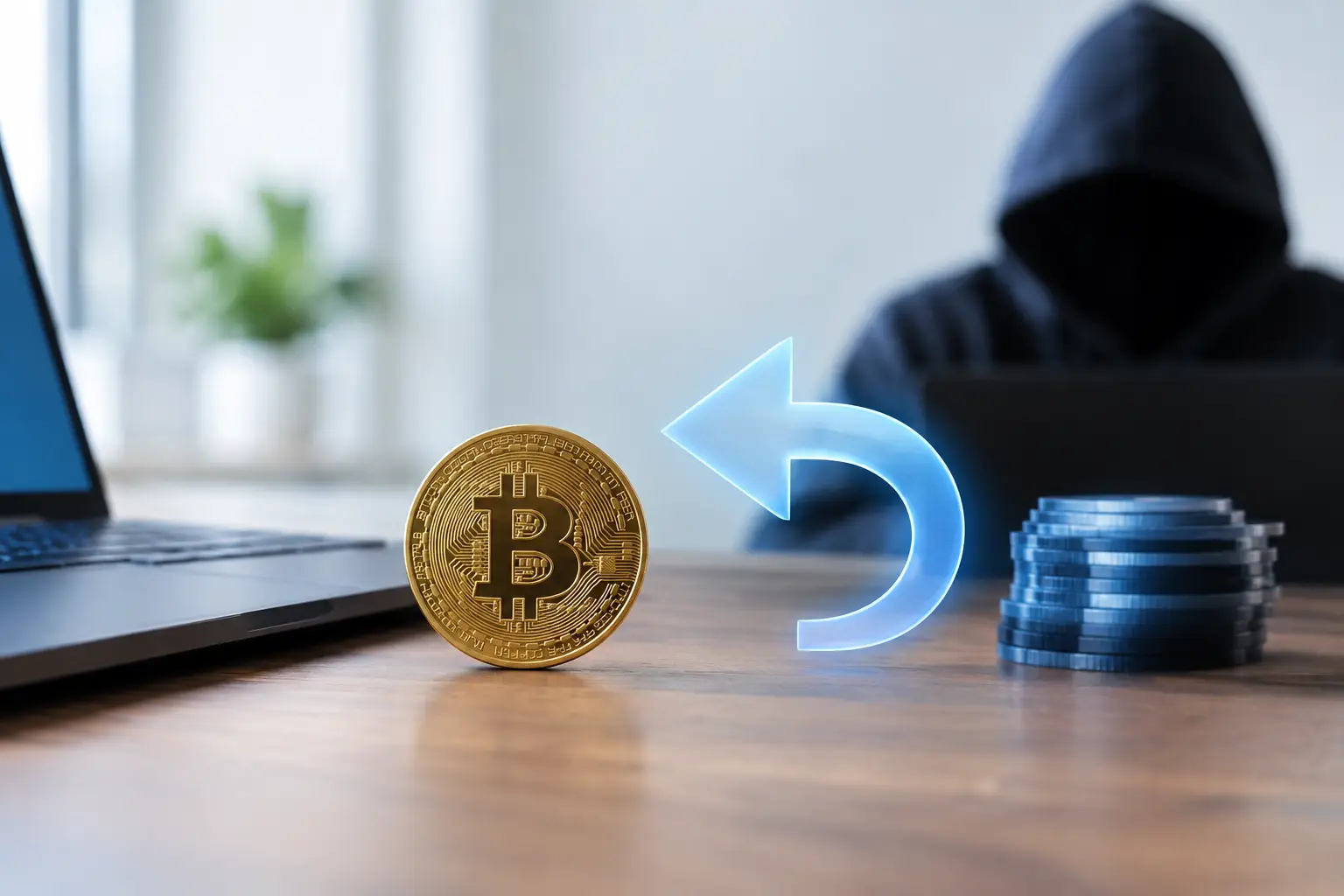
A scammer tells you to send cryptocurrency to “verify” an account, release a fake investment withdrawal, or pay a supposed recovery fee. The transfer leaves your wallet, and the question becomes urgent: can blockchain transactions be reversed? In most cases, no. A confirmed transaction on a public blockchain cannot simply be canceled, recalled, or reversed by the sender, a wallet provider, or a blockchain explorer.
That answer is difficult, but it should not be confused with “nothing can be done.” Public ledger architecture preserves a record of where assets moved. A disciplined review of that record can establish transaction history, identify wallet relationships, document exposure to exchanges or services, and preserve facts that may support a report, dispute, or law enforcement inquiry.
Why confirmed blockchain transactions are usually final
Blockchains are designed to replace a central transaction administrator with a distributed validation process. On networks such as Bitcoin and Ethereum, transactions are submitted to the network, validated under the protocol’s rules, and added to the ledger. Once sufficient confirmations or finality have been reached, the record is intended to be permanent.
There is no general “undo” function because no bank-like central party controls the ledger. If a person voluntarily signs and broadcasts a transfer using their private key, the blockchain records that authorized instruction. The network does not evaluate whether the recipient lied, impersonated a business, or used coercive tactics. It verifies whether the transaction met the network’s technical requirements.
This distinction matters in scam cases. A transaction may be technically valid while the circumstances surrounding it are fraudulent. The ledger can confirm that a transfer occurred, at a certain time, from one address to another. It cannot, by itself, determine whether the recipient made false promises.
The narrow situations where reversal may still be possible
The phrase “blockchain reversal” is often used too broadly. A few situations can create an opportunity to stop or recover assets, but they are not the same as reversing a finalized on-chain transfer.
Before the transaction is confirmed
A pending transaction may sometimes be replaced or canceled before it is added to a block, depending on the network, wallet settings, and the transaction type. On Ethereum-compatible networks, a sender may be able to submit a replacement transaction using the same nonce and a higher network fee. This is time-sensitive and technically specific.
Once a transaction is confirmed, that option is generally gone. Waiting to act while hoping a confirmed transfer will disappear can cost valuable investigative time.
When a custodial platform controls the receiving account
If the assets reach a centralized exchange, payment platform, or other custodial service, that organization may control access to the receiving account. It may be able to restrict an account in response to a credible report or legal process. The blockchain transaction remains on the ledger, but assets held by the custodian may become subject to its internal controls.
Outcomes depend on timing, the platform’s policies, the quality of supporting evidence, applicable legal procedures, and whether the assets remain at that service. No custodian is obligated to reverse an ordinary completed blockchain transfer simply because a sender regrets it or believes a scam occurred.
When the recipient voluntarily returns the assets
A recipient can send a new transaction back to the victim. That is a separate transfer, not a reversal. In fraud matters, voluntary return is uncommon unless the recipient is identified and compelled or persuaded through appropriate channels.
Exceptional protocol-level events
A blockchain community can theoretically adopt extraordinary changes after a major network incident. Such events are rare, controversial, and not a remedy available to an individual scam victim. They should not be treated as a realistic recovery path for a personal transfer.
What a blockchain record can reveal after a scam
Irreversibility is not invisibility. Most major public blockchains are architecturally transparent: transactions, timestamps, transaction hashes, wallet addresses, token movements, and smart-contract interactions can be reviewed by anyone.
For example, Etherscan can show the route of assets across Ethereum and compatible token activity. Blockchain.com can help examine Bitcoin transaction records and address activity. SoChain can provide transaction-level visibility across supported networks. These tools are useful for verification, but a search result alone is not a forensic conclusion.
An analytical review asks more specific questions. Did the recipient wallet move funds immediately? Were assets consolidated with transfers from other wallets? Did the wallet interact with a bridge, swap service, mixer, gambling service, merchant processor, or exchange deposit address? Are there repeated patterns that may indicate a broader operation rather than an isolated transaction?
Each answer requires context. A transfer to an exchange does not prove that the account holder is the scammer. A cluster of related addresses may suggest common control, but that conclusion must be supported by documented methodology and stated with appropriate limits. Sound asset tracing separates observable facts from reasonable inferences.
How to preserve evidence before it becomes harder to reconstruct
Scammers often pressure victims to delete chats, install remote-access software, move funds across multiple wallets, or pay additional “taxes” and “unlock” fees. Do not send more cryptocurrency to recover what was lost. A request for another payment to release funds is a common continuation of the fraud.
Preserve the original record promptly. Keep transaction hashes, sending and receiving addresses, wallet screenshots, dates and times, token names, amounts, network names, exchange withdrawal records, emails, text messages, social media profiles, websites, phone numbers, and payment instructions. Record information as it appeared at the time, including misspellings and usernames.
Do not rely solely on screenshots. A transaction hash allows an independent party to verify the on-chain event through a relevant explorer such as Etherscan, Blockchain.com, or SoChain. Screenshots provide context; the public ledger provides an independently observable transaction record.
If a scammer directed you through a fraudulent website or application, document the web address and the sequence of events. Note whether you connected a wallet, approved token permissions, disclosed recovery phrases, or installed software. These details may affect both the scope of risk and the interpretation of later transactions.
Can blockchain transactions be reversed through a wallet provider?
Usually, no. Noncustodial wallet software gives a user access to keys and signs transactions at the user’s direction. The wallet provider generally cannot retrieve assets after a confirmed transfer because it does not control the recipient’s private keys or the blockchain’s consensus process.
Custodial services are different because they hold assets or administer accounts. Even then, their ability to act is limited by where the assets are, whether the account can be identified, and the legal and compliance framework governing the matter. Contacting the relevant service quickly with precise transaction information may be appropriate, but it is not a guarantee of a freeze or return.
Be wary of anyone claiming they can “hack back” cryptocurrency, reverse a transaction for an upfront fee, or access funds through a special blockchain recovery tool. Legitimate investigative work documents the transaction trail and its evidentiary implications. It does not promise technical powers that public blockchain design does not provide.
From transaction data to usable findings
A raw block explorer view can be overwhelming. Wallets may hold many token types, interact with multiple smart contracts, or route assets across networks within minutes. A forensic tracing process organizes the data into a comprehensible chronology: source wallet, destination wallet, intermediate transfers, asset conversions, service interactions, and points where identification or preservation may be possible.
That process also accounts for uncertainty. Address attribution is not automatic. An address may be publicly labeled, associated with a known service, or linked through observable transaction behavior, but the identity behind a wallet often requires information outside the chain. Exchange records, device evidence, communications, subpoenas, and investigative coordination may be necessary to connect a ledger address to a person or entity.
For victims, education is a practical shield against further fraud. Understanding that confirmed transfers are generally final helps stop the cycle of sending additional funds to scammers who promise recovery. At the same time, transaction tracking can uncover patterns for law enforcement discovery.
Leave a Reply